Mac Terminal Download File From Server
- Download
- Microsoft Terminal Server Download
- Mac Terminal Download File From Server Linux
- Install Mac Os Via Terminal
- I need to download a file from server to my desktop. (UBUNTU 10.04) I don't have a web access to the server, just ssh. If it helps, my OS is Mac OS X and iTerm 2 as a terminal.
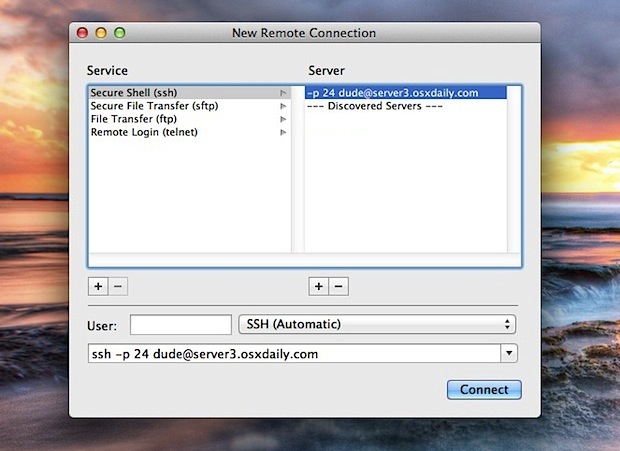
- Nov 07, 2016 Users can securely download a file from any remote server with SSH by using the scp tool at the command line.
Nov 18, 2019 curl figures out that we’re pointing it at an FTP server, and returns a list of the files that are present on the server. The only file on this server is a “readme.txt” file, of 403 bytes in length. Let’s retrieve it. Use the same command as a moment ago, with the filename appended to it: curl -u demo:password ftp://test.rebex.net. Here are some ways to make it easy to reconnect to shared computers and servers you frequently use: On your Mac, do any of the following: Choose Apple menu Recent Items, then choose from the list of recent servers. In the Finder, choose Go Connect to Server, click the pop-up menu to the far right of the Server Address field, then choose a recent server. Download minecraftserver.1.16.3.jar and run it with the following command: java -Xmx1024M -Xms1024M -jar minecraftserver.1.16.3.jar nogui Should you want to start the server with its graphical user interface you can leave out the 'nogui' part. Just so you know, by downloading any of the software.
Terminal User Guide
In Terminal, you can move and copy files locally or remotely using the mv, cp, and scp command-line tools.
Tip: It’s easier to move and copy files using the Finder. See Organize files in folders.
Move a file or folder locally
In the Terminal app on your Mac, use the
mvcommand to move files or folders from one location to another on the same computer. Themvcommand moves the file or folder from its old location and puts it in the new location.For example, to move a file from your Downloads folder to a Work folder in your Documents folder:
% mv ~/Downloads/MyFile.txt ~/Documents/Work/MyFile.txtYou can also change the name of the file as it’s moved:
% mv ~/Downloads/MyFile.txt ~/Documents/Work/NewFileName.txt
See the mv command man page.
Copy a file or folder locally
In the Terminal app on your Mac, use the
cpcommand to make a copy of a file.For example, to copy a folder named Expenses in your Documents folder to another volume named Data:
% cp -R ~/Documents/Expenses /Volumes/Data/ExpensesThe
-Rflag causescpto copy the folder and its contents. Note that the folder name does not end with a slash, which would change howcpcopies the folder.
See the cp command man page.
Download
Copy a file or folder remotely
In the Terminal app on your Mac, use the
scpcommand to copy a file or folder to or from a remote computer.scpuses the same underlying protocols asssh.For example, to copy a compressed file from your home folder to another user’s home folder on a remote server:
% scp -E ~/ImportantPapers.tgz username@remoteserver.com:/Users/username/Desktop/ImportantPapers.tgzYou’re prompted for the user’s password.
The
-Eflag preserves extended attributes, resource forks, and ACL information.The
-rflag, which isn’t used in this example, causesscpto copy a folder and its contents.
See the scp command man page.
This article describes the Remote Desktop Connection (RDC) client requirements to use Terminal Services Web Access in Windows Server.
Original product version: Windows Server 2012 R2
Original KB number: 943887
INTRODUCTION
Terminal Services (TSWeb) in Windows Server 2008 and Remote Desktop Services (RDWeb) in Windows 2008 R2 are role-based services that let users start RemoteApp and Desktop Connection from a web browser. RemoteApp and Desktop Connection provides a customized view of RemoteApp programs and virtual desktops to users. When a user starts a RemoteApp program, a Terminal Services session is started on the Windows Server 2008-based terminal server that hosts the RemoteApp program.
To start a RemoteApp program, a user connects to a website that is hosted on the Windows Server 2008-based TS Web Access server. When the user connects to the website, a list of available RemoteApp programs appears. Additionally, TS Web Access lets users connect to the remote desktop of any server or client computer on which the user has the required permissions.
Resolution
If you are using Windows Server 2008 R2, you must use RDC client version 7.
You must have the RDC client version 6.1 installed to use TS Web Access with the following operating systems:
Windows Server 2008
Windows Vista with Service Pack 1 (SP1)
Windows XP with Service Pack 3 (SP3)
Note
RDC 6.1 (6.0.6001) supports Remote Desktop Protocol 6.1.
Mac mail do not download attachments. In the Mail app on your Mac, move the pointer over the header of a message. Click the Attach button that appears, click the name of an attachment or choose Save All, then choose a location. You can also select a message, then choose File Save Attachments. Or drag an attachment from the message to the desktop to save it there. Recently, the Mail app started having problems with attachments. On many (but not all) messages, attachments show up, but they are displayed as 'Mail Attachment', not as the actual file name. Curiously, sometimes the correct icon shows up. I thought that maybe they needed some time to download, but waiting for hours does not solve it. An attachment is automatically saved to the Mail Downloads folder whenever you: Open the file with a double-click or with the Open Attachment command in its contextual menu. Control-click a file. In the Mail app on your Mac, do any of the following: Click the Attach button in the toolbar, locate a file (you may need to click the sidebar button to see additional folders), select it, then click Choose File. You can also drag files from the desktop, the Finder, or an app into your message.
If you are experiencing this issue on a Windows Vista-based computer, you must have Windows Vista Service Pack 1 installed on your computer. For more information about Windows Vista Service Pack 1, see Microsoft Knowledge Base article 936330: What you should know before you install Windows Vista Service Pack 1
If you are experiencing this issue on a Windows XP-based computer, you must have Windows XP Service Pack 3 or RDC 6.1 installed on your computer.
Advanced Information
Information for administrators
When users try to connect to TS Web Access from a computer that has an earlier version of the RDC client installed, they will receive an error message that includes a URL. This URL points the user to a webpage where they can find more information.
Currently, the URL that is included in the error message points to this Knowledge Base article. However, you can change the URL that is included in the error message. To modify the URL, use one of the following methods.
Method 1: Use an ASP.NET application setting
To change the URL that is included in the error message, use an ASP.NET application setting. To do this, follow these steps:
Click Start, click Run, type Inetmgr.exe, and then clickOK.
Expand the server name, expand Sites, expand Default Web Site, and then click TS.
Note
By default, TS Web Access is installed in the default website.
Under ASP.NET, double-click Application Settings.
In the actions pane, click Add.
In the Add Application Setting dialog box, type rdcInstallURL in the Name box.
In the Add Application Setting dialog box, type the URL for the webpage that includes more information about how to use TS Web Access, and then click OK.
Method 2: Edit the Web.config file
Microsoft Terminal Server Download
To change the URL that is included in the error message, you can edit the Web.config file for the TS Web Access website. To do this, follow these steps:
Open the Web.config file for the TS Web Access website in Notepad.
Note
By default, the Web.config file for the TS Web Access website is located in the Webts folder.
Locate the <appSettings> section in the Web.config file.
In the <appSettings> section, add the following entry:
Note
Mac Terminal Download File From Server Linux
The URL placeholder is the URL for the webpage that includes more information about how to use TS Web Access.
- On the File menu, click Save.
- Exit Notepad.
Information for non-administrators
If you are not an administrator, contact the system administrator if you have problems when you use TS Web Access. For example, the system administrator can help you obtain and install an updated version of the RDC client.
More information
Related Topic
Install Mac Os Via Terminal
- For more information about Remote Desktop Connection 6.1 in Windows XP, see Microsoft Knowledge Base article 952155: Description of the Remote Desktop Connection 6.1 client update for Terminal Services in Windows XP Service Pack 2
- For more information about security update for Remote Desktop Client version 6.0 and 6.1, see Microsoft Knowledge Base article 956744: MS09-044: Description of the security update for Remote Desktop Client version 6.0 and 6.1: August 11, 2009
- Depending on your version of Windows Server, visit one of the following:
- The Remote Desktop Services home page (Windows Server 2008 R2) on the Windows Server TechCenter.
- The Terminal Services home page (Windows Server 2008) on the Windows Server TechCenter.
- Remote Desktop Services in Windows Server 2008 R2 in the Windows Server 2008 Technical Library.
- Terminal Services in Windows Server 2008 in the Windows Server 2008 Technical Library.
Additional Resources
Click the following links to find more options if this article cannot resolve your problem: